



Black Book’s Used Vehicle Retention Index Drops for the First Time Since July of 2021
Seasonally adjusted Retention Index down to 193.0 points in February of 2022 as questions about the strength of the upcoming Spring market remain.

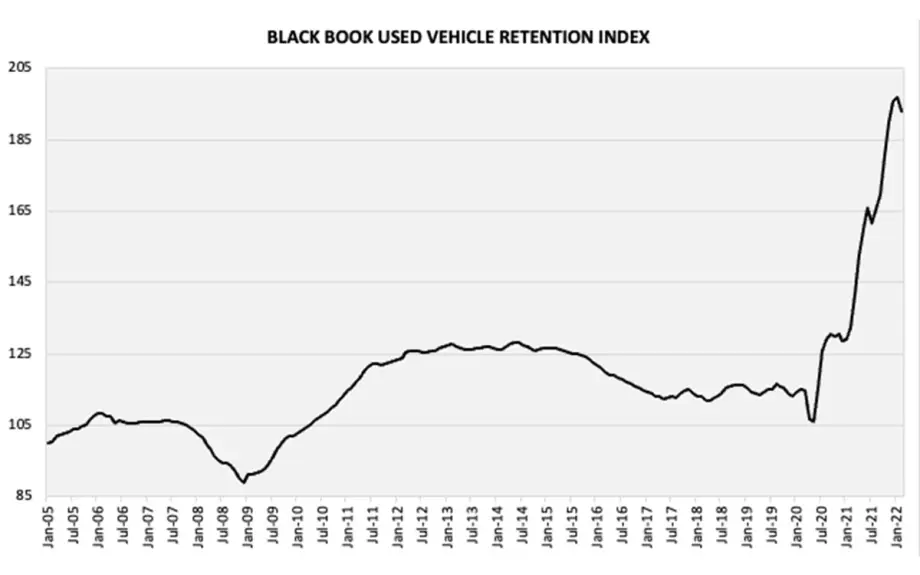
Seasonally adjusted Retention Index down to 193.0 points in February of 2022 as questions about the strength of the upcoming Spring market remain.
LAWRENCEVILLE, Georgia – Black Book, a division of Hearst that provides industry-leading used vehicle valuations and residual value forecast solutions, today released its Used Vehicle Retention Index for February 2022. For the first time since last summer, the Index decreased by 4.0 points (or 2.0%) to 193.0 points. The Index currently stands 68% above where it was at the same time in 2021 and 46% above February 2020 (just before the pandemic started).
“In February, we saw an accelerated decline of wholesale prices in all but two (Full-Size and Compact Vans) segments. That led to a decrease in the overall monthly seasonally adjusted retention index,” said Alex Yurchenko, Chief Data Science Officer at Black Book. “So far, it looks like the tax season boost to the retail demand is weaker than in a typical pre-pandemic year. We still expect a slower rate of decrease in prices in May with possible appreciation is some segments as the spring buying market arrives.”
The Black Book Used Vehicle Retention Index is calculated using Black Book’s published Wholesale Average value on two- to six-year-old used vehicles, as percent of original typically equipped MSRP. It is weighted based on registration volume and adjusted for seasonality, vehicle age, mileage, and condition. The Index offers an accurate, representative, and unbiased view of the strength of today’s used vehicle market values.
To obtain a copy of the latest Black Book Wholesale Value Index, please click here.
More Industry

Penske Auto Group Deal a Record
The deal to take the dealership and transportation services company private sets a new pace for industry buy-sell transactions.
Read More →
War Toll a Damper on Used Auto Prices
Cox Automotive found wholesale depreciation to be elevated in September amid high fuel prices and this year's unusual hurricane season.
Read More →
Bridge the Maintenance Gap
With many drivers missing recommended maintenance, service departments offering transparency and efficiency have a better chance of reaching financially strained consumers.
Read More →
California Store Has New Owner
The longtime dealership in the northern part of the state is known for robust fleet sales and has served the state capital for 115 years.
Read More →
BMW Plant Pursues Cleaner Energy
BMW Group Plant Leipzig has utilized hydrogen to help power its production since 2013, but a new pipeline is planned to take it to another level.
Read More →
Auto Affordability Inches Up
The latest Cox Automotive and Moody’s Analytics index shows a slight increase in new-vehicle affordability despite high prices.
Read More →
Ohio Auto Group Under New Ownership
After 79 years with the Schluter family, Mansfield Auto Group has been acquired by Missouri-based Clement Auto Group.
Read More →
RV Group Expands Carolina Footprint
Blue Compass RV Columbia Northeast is the 13th RV dealership owned by Blue Compass in the Carolinas.
Read More →
Agent Acumen
An Agent Summit panel of people who’ve been supporting auto dealers for years gave both timely and timeless advice for those starting out or mulling the prospect.
Read More →
Missed Maintenance Creates Opportunity
As families get back on the road and into daily school routines, service drives have an opportunity to capture customers who are behind on recommended vehicle maintenance.
Read More →