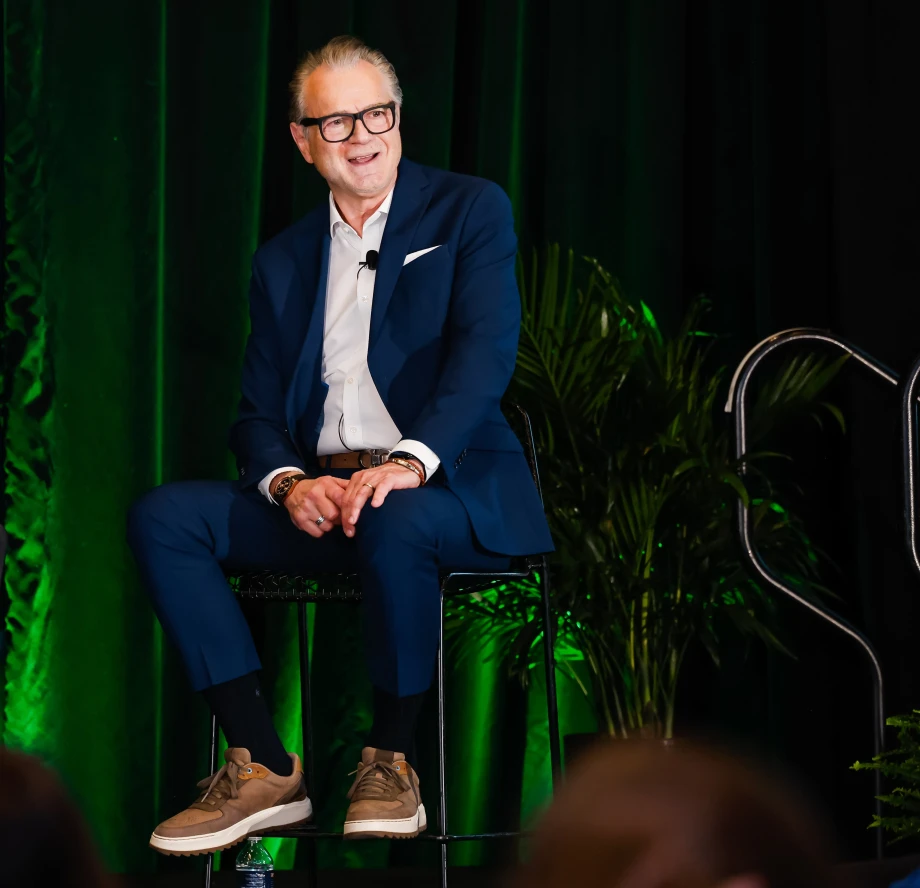
Mancuso, then a young man, listened with interest to what were novel ideas in his one-store family at the time. He didn’t know then that Ryan was opening up an expansive future for the elder Mancuso and his colleagues, not to mention himself when he later ran his own dealerships.
Decades since, he credits F&I and the agents who facilitate it for dealers as the cornerstone of auto retail. He pointed out that the profit center not only helps dealers bridge tough economies but builds their wealth to levels not imagined when Ryan visited the family store all those decades ago.
“Without what our agents provided us, we probably would’ve been a single-store family for 75 of our 100 years,” Mancuso said in a wide-ranging talk on the industry at this year’s Agent Summit.
More Hats
Mancuso reflected on general agents’ positive impact on dealerships while discussing how they have plenty of room to expand their role.
He sees agents as being all the more important now despite the rapid surge of artificial intelligence, which it turns out, according to recent CDK research, dealer principals are using more than anybody else at the dealership.
Agents can consolidate data and be the experts for dealers in sifting through it and applying it for profits. And they don’t even need AI to add that function to their duties because most agents already have a wealth of intelligence in their heads, Mancuso pointed out.
“I’ve always thought that agents in the field are like data collectors,” he said. “You’re exposed to so many different smart, successful dealers that you become just an incredible source of information. … There’s no reason in my mind, especially with technology, that you can’t become a one-stop shop from a data-collection standpoint for all your dealers.”
In fact, Mancuso added, agents should take a seat at the dealership conference table.
“I personally think you should be at the highest level of management discussion and policymaking in the dealership because there’s very little you don’t know about the operation.”
AI’s Role
Speaking of AI, which pretty much everybody at the summit was doing, it’s rapidly turning out to be an indispensable tool agents should employ as a kind of virtual secretary, if nothing else, Mancuso said.
“If you don’t spend 15 minutes a day on YouTube or X reading about and watching AI, you’re behind the 8 ball already. You’ve got to get with it. Everything from last week is old. It’s changing so fast, but look at the leverage it gives you. You can go into a marketplace. You can look at an individual dealer and do comparisons,” he said. “It would be a shame for you not to use that.”
For agents to help dealer clients with AI means being the AI expert in their stead, he said. And though most people use the technology to search for information, he sees that as a waste of the resource.
“You can outdo the best digital marketing companies if you have a little bit of inside knowledge about the stores you’re working with. You can be bringing things to the dealer that the dealer didn’t ask for, and to me that’s the definition of value.”
As for what AI could do for agents’ own operations, there’s no lack of options, Mancuso pointed out.
“Let your imagination run wild. Timing is everything, and AI is hitting at the right time.”
Agents can tap their preferred AI platforms to conduct research on potential prospects or to unearth valuable information for their clients, he said.
“You can get a peek under the tent at what’s happening in the market, maybe a peek under the tent at something happening at one of your client dealerships where they’re not measuring up to the competition in a certain area.”
Looking Back
Mancuso’s knowledge of automotive retail is broad because of his family’s long involvement in the industry and his experience in multiple corners of it.
His upstate New York-based great-grandfather got into a niche area of the business during the Prohibition era by prepping cars to carry heavy loads of liquor transported from Canada, where alcohol manufacturing and consumption remained legal.
The Mancuso forefather entered the sanctioned end of the industry when a Packard representative, noticing all the cars parked outside his garage, asked if he wanted to become a dealer for the luxury automaker. The elder Mancuso agreed to the proposition.
Mancuso’s grandfather and father later joined the business. His father moved to Chicago in the 1950s to work for a Cadillac store, then secured his own Chevrolet franchise.
The latter store is where the youngest generation of the family fell in love with cars at a tender age, both Mancuso and his brother, Rick, who went on to become a Ferrari dealer awarded for best service in the world by the Italian brand.
“I knew from the day I was old enough to know anything that I wanted to get in this business,” Mancuso said, recalling the school breaks he spent at the dealership. He started working there when his father gave him a key to the store when Mancuso was 15.
The boy watched as his father built a solid reputation in the industry and served on the public relations committee of the National Automobile Dealers Association. He also saw him turn down franchise offers from the likes of Toyota, Mercedes, Porsche and Audi. The Chicagoan was a General Motors dealer and didn’t trade in foreign makes, the elder Mancuso told them all.
Despite later getting a degree in psychology from Princeton University, Mancuso wanted to help his dad sell cars after graduation and never looked back. His father soon bought a small Cadillac franchise for his son, who made his share of mistakes in his freshman venture, including draining his business bank account dry at one point.
“I did everything I could to screw this thing up,” he recalled. But his father helped get him back on track, and the young man snagged an open-point Honda store while his brother forged his own path.
Mancuso’s natural desire not only helped him make his way in the industry but brought him success and durability because, “It’s hard enough if you want to do it,” he said. “It’s real tough if you don’t want to.”
Desire or not, when a growing auto group later offered to buy what had grown to four stores, he accepted, telling his unhappy father, “I can’t make this kind of money if I worked the next 20 years.”
Mancuso, owing to strong relationships he’d built with providers over his nearly 25 years in the business to that point, then worked for Western Diversified and Pat Ryan’s automotive group in marketing, communications and investor relations.
But his car-selling bug hadn’t died, and he returned to the showroom with a run as a high-end sports car dealer, including stints with McLaren and Lotus over the course of a decade. By that point, he was finally ready to leave auto retail.
Mancuso is now partnering with his brother on a couple of projects, including a radio show about all things automotive that launched in June called “The RPM Club” and a “high-level” Corvette restoration enterprise.
Futuristic
Due to Mancuso’s broad perspective on the business, he still maintains a strong bead on how conditions may develop, despite the volatility that has shaken it in recent years.
In addition to AI’s role, he sees electric vehicles as a mainstay. That’s despite deflated interest after a federal incentives pullback and continued consumer concerns about public charger availability.
“They’re not going away,” he said. “There’s a boatload coming off lease now. There’s going to be some incredible deals on the used car lots.”
Mancuso sees coverages for EV components, such as their expensive batteries and their abundance of electronics, proving to be strong revenue streams for dealers.
EV demand would likely have been much greater by now if EV makers had done a better job selling them, including U.S. market leader Tesla, he said.
“Early adopters can keep a business going for a long time, but it’s been since 2012? I don’t know how much longer they can do that without advertising,” he said of Tesla. “If they turn on the marketing dollars, oh boy, just wait, and it doesn’t hurt them that gas is $4 or $5 a gallon, for now.”
As for the franchised dealer, Mancuso sees no real threat to the business model, despite Tesla and other EV makers’ direct-sales approaches. In fact, direct sales aren’t new, he said, giving as an example dealerships Cadillac used to own outright – his father’s first job was working for one of them in downtown Chicago.
The model was never cemented, though, he said, because automakers didn’t want to invest in an expensive national footprint and staff. And though the franchise arrangement may be adversarial at times, it’s enduring.
“There’s too many franchise laws in every state in this country to say franchise dealers will go away. You don’t need to worry about that,” he said.
“They are big contributors politically. And the factories, they might talk about some direct-to-consumer opportunities—Scout’s trying to do it, and it’s really pissing off the VW dealers. I don’t think that’s going to spread at all, especially with the horsepower behind the big groups that are buying up so many stores.”