
F&I
Parsing Out Profits
As auto dealers have had to settle for normalized bottom lines after reveling in unprecedented pandemic-era highs, product sales have cushioned the fall.


 MENU
 SEARCH
As auto dealers have had to settle for normalized bottom lines after reveling in unprecedented pandemic-era highs, product sales have cushioned the fall.
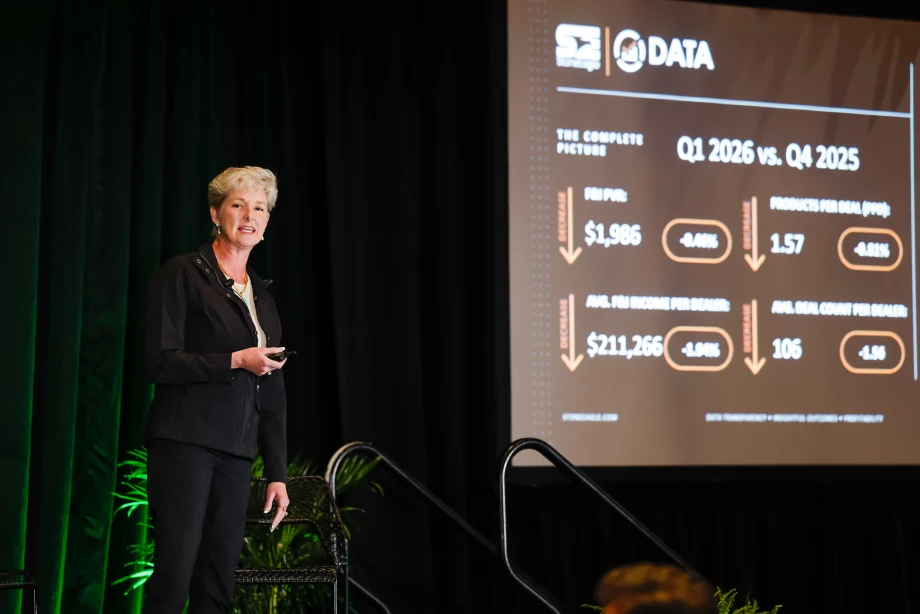
StoneEagle CEO Cindy Allen marveled at auto retail's solid product penetration at this year's Agent Summit as she reviewed its positive impact on dealers' bottom lines.
Expo Ease
Auto dealers might not be in the money they swam in during the pandemic, but they’re still making a sight more than before it.
StoneEagle CEO Cindy Allen and her staff have been following the numbers in aggregated transaction data generated by company products. And it’s clear that finance-and-insurance offerings have proven their mettle as the dealership’s profit-maker since the great market disruption faded.
As the front end’s share of total profit per deal has plummeted from 59% in January 2022 to 22% this spring, back-end share has ballooned from 41% to 78%.
Just comparing the first quarters of last year and this year, average F&I income per dealer rose about 3% to $211,266, according to StoneEagle data. And that’s despite the average deal count per dealer being down about 5%.
“We just have a really great product penetration,” Allen said in a presentation at this year’s Agent Summit.
That’s the case despite increasing consumer affordability erosion, though many Americans are hitting a wall when it comes to what they’re willing to add to their budgets.
When the average auto loan payment reached more than $700 in the fourth quarter, “we started to see a decline in some other purchases in the deal itself from a product perspective,” Allen said. “There is a limit in our current economy in what people can pay for the car, so we’ve been bumping up against that.”
Dealers, though, are finding ways to manage the pressures. Since January 2025, F&I profit per-vehicle retailed is up 10% and product purchase per deal about 4%, according to StoneEagle data.
“What our dealers are able to do from pulling the various levers and managing all the numbers in a deal is just amazing to me,” Allen said.
Though U.S. dealers’ average front-end profits fell precipitously from a pandemic high of $2,926 in December 2021 to $539 this March – an 80% plummet – that’s amazingly still up 33% over 2019 figures.
“It’s really rough to come down that mountain,” Allen acknowledged. “To see an 80% reduction from where we were at the top of the mountain to where we sit today in front gross is painful.”
There’s a bright spot even in that dark corner of the dealership, though, she said. Before Covid, front-end dealer profit averages stayed in negative territory, but today’s new-vehicle sales normal is an above-zero average, according to StoneEagle research.
“It’s up $281 since the norms pre-Covid,” Allen said. “Fantastic, I think.”
Meanwhile, dealers have been adjusting their rate spreads to make buying conditions more realistic for customers. In the 14 months leading up to Agent Summit, dealer markups fell 35% while lenders’ buy rates ticked down just 4%, Allen said.
“This is one of the things I think points to how smart our dealers are and how they pull the various levers needed to drive profitability but also figure out how to get those consumers into a vehicle despite everything that’s happening in the economy, despite the conversations around affordability.”
While dealers’ other business moves play their parts in keeping profits up, Allen returned to the star of her presentation, F&I per-vehicle retail, to bring her major takeaway home.
In just the shorter-term view from January 2024 to this March, StoneEagle noted 15% growth in the metric to a neat $1,999. Looking back to prepandemic January 2019, that’s a stunning 60% pop.
“This has been the foundation of stability and profit for dealerships through the long haul,” Allen said.
Last November saw an even bigger spike of $2,025 average PVR, StoneEagle calculated, and the figure has since hovered around $2,000.
The product heavyweights of vehicle service contracts and guaranteed asset protection insurance coverage have performed steadily for dealers over what’s been a volatile period in auto retail, to say the least, from the pandemic to today’s consumer affordability challenges.
At the same time, average dealer VSC income has climbed 12% since January 2022, Allen said.
During that period, GAP coverage penetration is up 5% and has generated 15% more income on average for dealers, according to StoneEagle numbers.
But Allen sees the smaller ancillary revenue streams as the real F&I strength center.
“My belief is that those ancillary products are the star of the show when it comes down to what’s been able to help dealers move the needle across all the tough times.”
As of the first quarter, ancillary product sales made up a third of dealers’ F&I product revenue, a 19% jump since 2020.
That strong slice of product growth was led by paint-and-fabric offerings at a 20% clip, a segment whose penetration jumped 76% while its dealer income generated grew 34%.
“They really are providing a tremendous amount of strength and revenue that adds to that stability we see” in contrast to the front-end gross volatility, Allen said.
Tire-and-wheel products, meanwhile, are gaining steam, helped in no small part to growing electric-vehicle adoption, Allen said, pointing out the greater number of tires heavier EVs run through. The segment’s penetration sat at 10% in March, but its income growth since 2020 has been about 63%.
Allen noted that a big factor in ancillary product growth comes in dealers’ leveraging of bundled packages. And though many customers balk on a full package due to affordability concerns, the bundle presents a chance to introduce them to products they can buy individually.
“It gives more of a chance to introduce the concept to the consumer,” Allen said. “That’s a really smart way that they’re using the ancillary conversation as a stepping process to get to the customer walking out with more and more product.”
When all is said and done, consumers, though some may be less than trusting of dealerships and the vehicle purchase process, are seeing the value of F&I products, and the numbers prove it, Allen said.
“They’re coming back and rebuying products, and they wouldn’t buy something they didn’t find value in a second time, but we’re seeing a lot of that. About eight out of 10 gross dollars per deal, come in from F&I so far in 2026.”
Loading data...
F&I
As auto dealers have had to settle for normalized bottom lines after reveling in unprecedented pandemic-era highs, product sales have cushioned the fall.







Training
A compliance-first F&I Strategy for today's auto dealer is essential given recent enforcement actions on the state and federal level. Here’s how to help your dealer-clients establish it.
Industry
An Agent Summit panel of people who’ve been supporting auto dealers for years gave both timely and timeless advice for those starting out or mulling the prospect.
F&I
General agents have a different roadmap for success than their predecessors. It will pay for them to follow it in order to be true dealer partners.
Industry
Rob Mancuso, who comes from a long line of auto dealers, values general agents’ place in the industry and makes a case for them taking an even bigger seat at the table.
Industry
The secret to both amazing barbecue and compliance is the same: understanding the basics and committing to a process.
Sales
Reflections from the 2026 Agent Summit: gratitude, gut decisions, and the power of the first contact
Industry
Auto dealers don’t have to settle for high employee turnover. Despite historical patterns of rotating dealership doors, they can tweak their processes to find and keep the right people on staff.
F&I
A StoneEagle 2025 industry report reads like a stress test. In a noisy year, F&I became the foundation that kept the house standing when the front end thinned.
Industry
Several automotive industry experts offer their advice on establishing an agency and building it to your highest potential.
Industry
As America turns 250, explore how the automotive industry shaped jobs, culture, innovation, and mobility from Detroit assembly lines to today’s EV era.