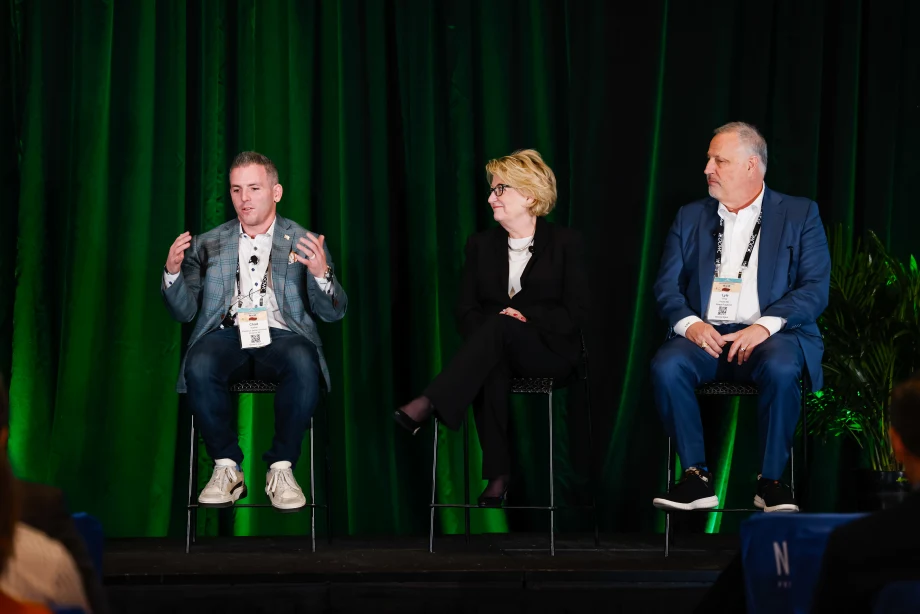
- Lyle King, who built an agency, sold it, retired and hated it, started ProfitLink in 2023.
- Chad Staples joined the greater auto retail industry in the mid-2000s and founded Elevation Dealer Services, also in 2023.
- And Cheryl Wiesenberg, founder of Drivewise in 1994, has been in the business for nearly 50 years.
Together, they’ve observed agencies from every angle. Despite their varied industry journeys, the panelists offered timeless wisdom, along with some of the latest counsel.
The Fundamental Fundamental
Wiesenberg perhaps spoke for the whole panel when she observed at one point that “relationships are everything” for agents.
“We really work to foster good relationships with our vendors and our dealerships so we can learn from each other and help to better the process, the procedures for everyone involved,” the industry veteran said.
When the relationships are solid due to supporting dealer clients, including when things go awry in a store and a customer is upset, referrals tend to come naturally, she added.
“As a result, we have grown organically as our dealerships have grown, and we also find we get tremendous repeat referrals from those who have worked with us in the past and know that we’re there for them to support what they’re doing,” Wiesenberg said, adding that helping dealers watch costs in today’s inflated market bolsters those relationships.
Staples agreed, saying his agency helps dealers take care of customers through products with exclusionary coverage and proactive management of those products, “making sure they understand that if losses are spiking that we’re going to increase rates on a quarterly basis and really monitor it.”
Setting Yourself up for Success
Before establishing supportive relationships, an agent must work to lay a solid foundation for business. King, who’s now built two agencies, said he learned the hard way to make that a team effort.
“I’ve done my best this time around to not take all the responsibility on, but I used to. I’ve tried to delegate responsibility. I’ve tried to hire people with certain capabilities,” he said.
To that end, King is ready to focus his next two hires on covering essential pieces he hates: pesky software integration issues and problem claims.
Agents should structure their businesses in the ways that best suit their management styles, strengths and weaknesses, King’s story illustrates.
For instance, Staples puts a premium on documenting processes at Elevation. The agency established a process for each menu provider, product line and setup.
“Then you can set the expectation with the dealer and be able to really perform and prove that you’re going to do it on the timeline that makes sense so you’re not setting yourself up for failure and frustration,” he said.
What You Offer
Of course, agents must bring a suite of products to their clients that work for them, but that can be complicated.
Wiesenberg knows that a wide variety of factors influence which products fit best for a particular dealer, so the fuller the product toolbox an agent carries, the better.
“We try to meet the dealer where he’s at, and that can vary, based upon region, based upon are they selling imports, domestics, new, used and what their concerns are within the marketplace,” she said.
“As a result that means unfortunately that one size doesn’t fit all, and it may mean that it’s not necessarily a service contract company that we’re providing. What we’re providing is ancillaries or consultation service, compliance services, and we find it grows from there.
Tailoring product lines to clientele and prospects also means agents must keep on top of what their competitors are offering. Staples said his agency asks a lot of questions of its clients to determine their market challenges and needs and what they want and don’t want.
“When you have competitors in there you’re going in blind, you don’t know what you don’t know,” he said, “and if you have a little more understanding of maybe some holes in their product or challenges organizationally, you’re able to not talk poorly on them but show the value in what you’re presenting, and that really sets you up for more success.”
King said he learned the hard ways years ago to secure multiple administrators for his clients. Fifteen years ago, he said he funneled 95% of his business through a single administrator, and when that one filed for bankruptcy he was up a creek without a paddle.
“I don’t think my administrators like it, but my strategy is pretty simple,” he said. “I’m still going to spread my business around for my health, as well as for the dealer’s health.
Profit-Building Prowess
Speaking of dealer health, with front-end margins and consumer affordability
shrinking, they’re looking for ways to increase returns in other ways. Participation options are a natural offering for agents.
King tries to show all of his clients the benefits such programs and to discuss the performance of said programs with those who already tap them.
“It’s pretty easy to justify why we need rate increases when they simply look at parts, tariffs, things of that nature, that have affected end-loss ratios if they’re in a reinsurance position,” he said.
“They’ve seen them shoot up 15%, 20% in many cases, and showing them the long-term effect on their participation position has been the biggest driving factor.”
Panel moderator Matt Romanoski, iA American Warranty Group’s national sales director, agreed on that value proposition.
“When we do session reviews with our clients, especially recently, we’re really leaning on the stats and what’s happening within the marketplace,” he said, “with engine claims being up 46%, transmission claims up 53%, parts costs up 44%, labor costs up 49%, tire-and-wheel up 47%.”
Selling Yourself
Once you’re fully equipped with everything your dealer clients may need, it’s obviously important to spread the word around to pick up more business. With today’s plentitude of self-marketing avenues, that task is simpler than ever.
Staples has availed himself of the free marketing tools of social media platforms, helped along by the guidance of online influencer Gary Vaynerchuk to good effect, he said. His guidance principles are that his posts should be educational and/or entertaining.
“Nobody likes an infomercial,” he said.
Staples started slow, then met a market agency owner who shoots dozens of videos for his posts at a time, Staples narrowing ideas to dealer-centered ones “focused on creating awareness in our industry and maybe changing the perspective that customers have against dealers and educating them on the market we’re in today.”
He said he gets leads from the effort, he believes because it breeds familiarity among prospective clients who recognize competence.
King, meanwhile, grows his agency by hiring representatives with established dealer relationships.
“Hiring former lender reps has been very fruitful for me. Hiring people who’ve been in F&I in stores, they’re technically capable people, but they typically don’t have as many connections as people who’ve been on the supply side,” he said.
But he doesn’t discount online marketing, either, making sure he keeps staff with those new-generation skills.
“While it’s not nearly to a dominant level or anything like that, we have a constant lead flow.”
To Sell or Not to Sell?
After agents have established themselves in the market and are building on that foundation, they may start thinking about selling the business, even if only in the distant future. King said it pays to think carefully.
The agency veteran learned from selling his first agency that it’s not always an easy process and not the solution for every agent.
“If I had a time machine and could go back, I would not have sold,” he said. “As an entrepreneur, I love being in business. I’m a terrible employee, and I know that.”
The problem for people like King is that an agent is often locked into working the buyer of his or her agency for some time after the sale.
“That period of time where I worked for the company that bought me and the period of time I was iced out due to noncompete or nonsolicitation agreements or disputes that arose out of the last couple of things, I basically feel like served a 10-year prison term.”
King established ProfitLink after getting free from the arrangement, and he said he applied another lesson at that point: delegation versus controlling most everything as he did with his first agency.
“Now I have a couple of people, and I’ve given them a lot responsibility as sales management for the rest of my producers, where I did that before. I have a person who’s my operations manager … I’ve relinquished the vast majority of that to employees. I’m a lot happier now.”