



Car Buyers Are Back, Just Not in the Dealership
In order to succeed in this new normal, dealerships will need to evolve and leverage the modern technologies available to them in order to meet consumers where they are – in their homes.
In order to succeed in this new normal, dealerships will need to evolve and leverage the modern technologies available to them in order to meet consumers where they are – in their homes.
IMAGE: BDEX
The COVID-19 pandemic dealt a swift and severe blow to automotive dealerships across the nation. As many parts of the country began to issue stay-at-home orders, dealer lots experienced a dramatic decline in foot traffic, which continues to this day.
The truth is, the automotive industry has been long overdue for a digital transformation.
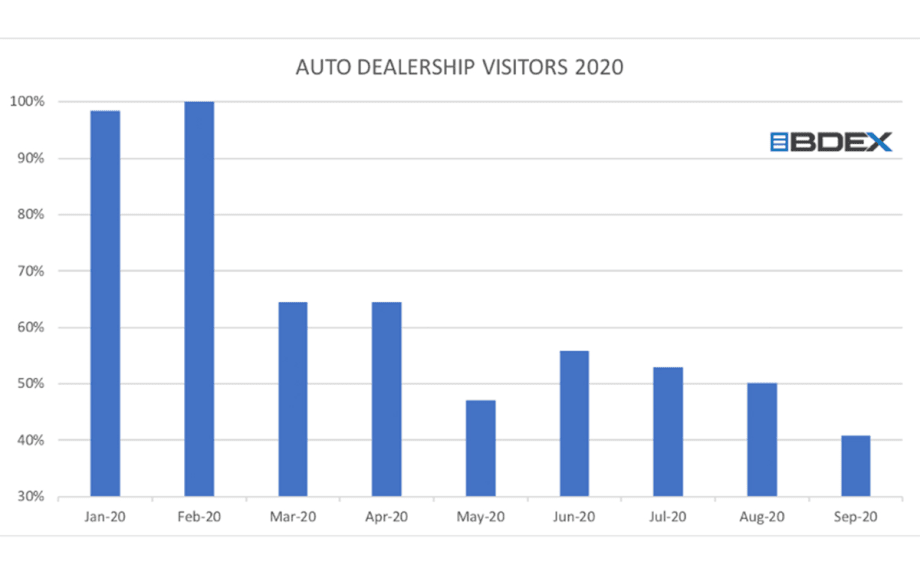
According to BDEX analysts, March and April of 2020 saw a precipitous 40% decrease in consumer traffic to auto dealerships in the United States. As the pandemic continued to spread, by May those numbers dipped below 50% and have mostly stabilized in that range since.
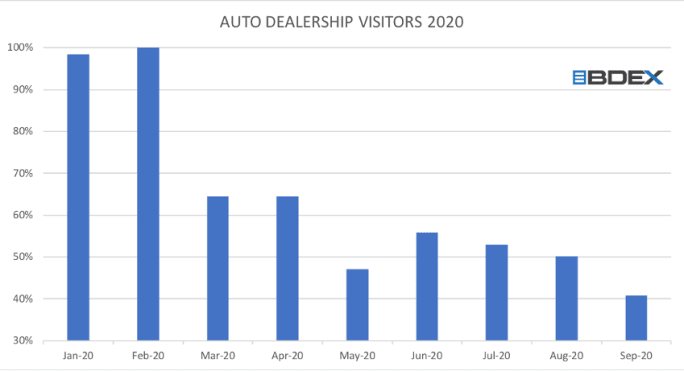
Note: Included is the volume of geolocation auto dealership visitors for 2020. Data is normalized to max volume of 100% in February 2020.
At first, many in the industry thought that consumers were simply waiting it out and putting their car shopping on hold until the economy becomes more stable. The expectation was that once the initial shock subsides, dealerships will go back to business as usual. However, this no longer seems to be the case.
According to the numbers by the U.S. Bureau of Economic Analysis, total vehicle sales across the U.S. began their V-shaped recovery as early as April. And even though the global COVID-19 pandemic continues to rage on, consumers are now buying their cars and trucks at nearly pre-pandemic levels. Unfortunately, the same can’t be said about dealership traffic, which continues to decline and is now at just 40% of its pre-pandemic rates.
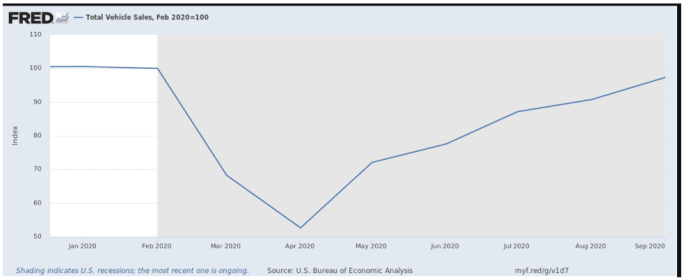
What this data shows is that consumers’ shopping behaviors have evolved, and dealers may not see business as usual any time soon.
As the industry started to evolve, dealers began communicating with customers over Zoom, sharing digital resources and online car reviews, and completing the buying process entirely remotely. Likewise, consumers started to feel more comfortable making some of the biggest purchases of their lives utilizing online configurators and VR test drives, or turning to YouTube to learn more about vehicles they are considering to buy. In this new normal, the auto dealerships that adapted to this digital environment are thriving, and the rest should take note because there’s no reason to think these changes are going anywhere.
With sales now more likely to happen at customers’ homes rather than on car lots, auto dealerships need to learn how to generate and manage these digital connections in order to remain competitive in this new landscape. And with the early adopters of internet-based car shopping, such as Carvana and CarMax, rapidly gaining market share, it’s imperative that brick-and-mortar dealerships react quickly and start thinking outside of the showroom when it comes to marketing and advertising.
Here are a few starting points that can help dealers launch their digital transformation and a more effective marketing strategy for 2021:
Track All Website Traffic
With less foot traffic at dealerships, tracking web traffic effectively is more important than ever: a new visitor on your webpage is today’s equivalent of a customer walking through your showroom doors. Dealers need to have the ability to know who is visiting their website and how to reach them even if they do not completely fill out a contact form. By investing in better and more up-to-date data analytics, dealers can have actionable intelligence on who is shopping online, coming off a lease, or browsing their site. This information can then be used to turn anonymous online users into known, real time sales opportunities.
Personalize the Buying Experience
Given that increasingly more car sales are now done online, dealerships must learn how to make their customers’ purchasing experience just as seamless and personal as an in-person transaction. This can be accomplished by investing in an omnichannel shopping experience that can improve your customer journey and enable seamless transitions between online and in-store activity. The ability to provide a personalized experience helps increase customer satisfaction and retention, making them more likely to return for their next car purchase.
Leverage Real-Time Consumer Data with AI-Enabled Analytics
The automotive marketing industry has traditionally relied on reusing the same consumer data for years, which makes it difficult to determine whether your messages are making an impact or reaching the right people. Knowing when a potential shopper is ready to buy will be crucial in this new virtual environment. Fortunately, modern consumer data platforms with artificial intelligence capabilities are able to automatically identify potential car shoppers based on geofenced, behavioral, and identity data. Once the system identifies a match in your area of operation, your team can be notified immediately and reach the right people at exactly the right time.
The truth is, the automotive industry has been long overdue for a digital transformation. The past year has made it abundantly clear that consumer behaviors have changed, and things may not be going back to normal any time soon. In order to succeed in this new normal, dealerships will need to evolve and leverage the modern technologies available to them in order to meet consumers where they are – in their homes.
David Finkelstein is an internet pioneer, tech entrepreneur and founder of numerous internet companies dating back to the earliest days of the internet in 1994. He currently serves as the Co-Founder and CEO of BDEX, an Inc 5000 company, the first and the largest consumer data exchange platform in the U.S.
Originally posted on F&I and Showroom
More Industry

Penske Auto Group Deal a Record
The deal to take the dealership and transportation services company private sets a new pace for industry buy-sell transactions.
Read More →
War Toll a Damper on Used Auto Prices
Cox Automotive found wholesale depreciation to be elevated in September amid high fuel prices and this year's unusual hurricane season.
Read More →
Bridge the Maintenance Gap
With many drivers missing recommended maintenance, service departments offering transparency and efficiency have a better chance of reaching financially strained consumers.
Read More →
California Store Has New Owner
The longtime dealership in the northern part of the state is known for robust fleet sales and has served the state capital for 115 years.
Read More →
BMW Plant Pursues Cleaner Energy
BMW Group Plant Leipzig has utilized hydrogen to help power its production since 2013, but a new pipeline is planned to take it to another level.
Read More →
Auto Affordability Inches Up
The latest Cox Automotive and Moody’s Analytics index shows a slight increase in new-vehicle affordability despite high prices.
Read More →
Ohio Auto Group Under New Ownership
After 79 years with the Schluter family, Mansfield Auto Group has been acquired by Missouri-based Clement Auto Group.
Read More →
RV Group Expands Carolina Footprint
Blue Compass RV Columbia Northeast is the 13th RV dealership owned by Blue Compass in the Carolinas.
Read More →
Agent Acumen
An Agent Summit panel of people who’ve been supporting auto dealers for years gave both timely and timeless advice for those starting out or mulling the prospect.
Read More →
Missed Maintenance Creates Opportunity
As families get back on the road and into daily school routines, service drives have an opportunity to capture customers who are behind on recommended vehicle maintenance.
Read More →