



GM's Drive: Getting Out of Debt

General Motors Co.'s finance chief is engineering a radical shift in the car maker's strategy—to pay off virtually all its borrowing in a few years and keep debt at close to nothing.
GM, like many industrial companies, long operated with billions of dollars in borrowed money. But its high debt was among the problems that landed the company in a U.S.-funded bankruptcy reorganization last year when car sales slumped, The Wall Street Journal reported.
Now, new managers from outside the industry are rethinking how GM operates, including its addiction to debt.
Chris Liddell, a former Microsoft Corp. chief financial officer who joined GM in January, surprised investors when pitching the company's initial public stock offering this fall by promising GM would pay off about $25 billion in debt and pension obligations. GM, he said, would hold only a token amount of debt—mainly to maintain a credit rating—for the long term.
"We want to be the masters of our own destiny" and not rely on borrowing from others, Mr. Liddell said in an interview.
That would be a dramatic departure for GM, which like its Detroit rivals had long carried a large debt load to help finance the business through the industry's periodic downturns.
Many companies and the analysts who follow them consider debt a valuable business tool. Leveraging a well-run company's high credit rating by selling bonds is a long-established way to fund a business. Debt also brings certain tax benefits.
Many car makers and parts suppliers are rethinking their use of debt since the financial crisis curtailed funding. But GM is in a peculiar situation. Debt is what helped sink the company and now—as it has returned to the stock market—it needs to prove it is being run more prudently. And GM already has $45.4 billion in world-wide tax benefits from losses and other factors.
"The new GM is trying to be the new GM," said Gimme Credit analyst Kimberly Noland. Yet over the long term she sees GM needing to return to borrowing.
In 2006, Ford Motor Co. borrowed close to $25 billion to pay for its future operations. Ford looked smart after the economic crisis prompted banks to cut off auto companies. But now, Ford is faced with far more debt than GM and has been working to pay it down.
Meanwhile, a low-debt approach by Toyota Motor Corp. helped the Japanese company continue to pump money into vehicle development last year even as it faced its worst financial performance in history.
Still, GM's plan carries risks. Should the car market again fall severely, GM may not be able to keep funding new vehicles and other investments through current earnings alone.
Standard and Poor's credit analyst Robert Schulz said the goal of maintaining capital spending without debt is reasonable as long as GM continues to generate cash in its key North American business. Mr. Schulz said it is "not unrealistic" that GM would meet its goal of nearly eliminating debt in the next few years.
The fact GM can even consider a low-debt future is a byproduct of its bankruptcy, which slashed the amount it owed creditors. Before Chapter 11 GM had $45 billion in debt, which cost it over $2 billion in annual interest. Last month, it had $12 billion in debt and preferred shares, though it still owes its global pension funds $23 billion.
Bankruptcy also cut GM's cost of operations through union concessions and plant closings. That shrunk GM to the point it can make money even in this year's anemic car market.
"We are in a cyclical industry with high fixed costs," said Mr. Liddell. "Overlaying financial leverage on top of that makes no sense."
During GM's so-called road show to pitch the IPO, some potential investors questioned whether the company's aggressive debt-repayment plan would backfire by taking money away from potential investments in products and elsewhere.
Mr. Liddell said some GM executives had the same question but ultimately decided that GM has ample resources to both adequately invest and pay off debt.
In wiping out most debt, GM hopes to cut the tie between sales levels and its ability to invest in vehicles. Such cutbacks exaggerate the effect of a downturn since new vehicles typically take three to four year to develop.
"The whole idea is that we should invest in research, development and capital irrelevant to where the market is," Mr. Liddell said.
That would be a contrast to the recent economic crisis. In 2009, as sales plunged and revenue fell, GM cut capital spending by nearly 30% from the year before to $5.4 billion. That temporarily halted development of several critical vehicles, including the next line of high-profit pickup trucks.
Today, the weakened product pipeline ranks among the top concerns of GM executives. Under the new plan, GM will use its profits to pay down debt each quarter. The company plans to maintain an annual capital budget of $7 billion and commit another $7 billion to engineering costs, mainly employees to develop products.
At the same time, the auto maker expects to sell a stake in former parts arm Delphi Corp., acquired last year for $1.7 billion, and may offload shares in former finance arm GMAC, now called Ally Financial, once the bank returns to the public markets, said people familiar with the matter. GM also has $3 billion to $4 billion in noncore assets it could sell, the company has said.
All these proceeds would go to debt reduction, though GM won't pay off around $10 billion in non-U.S. pension obligations since they are funded on a pay-as-you-go basis.
GM in addition would hold off paying dividends to its new stockholders for an unspecified time, Mr. Liddell said.Mr. Liddell said GM can stick to the debt-reduction goal as long as the seasonally adjusted U.S. industry sales rate doesn't fall below the current 10 million vehicles a year and GM doesn't lose more U.S. market share.
Anticipating GM may again borrow at least some money, Barclays Capital and Goldman Sachs on Tuesday began quoting prices for credit-default swaps for GM debt, a way for investors to insure against losses in any bonds GM may issue.
More Industry
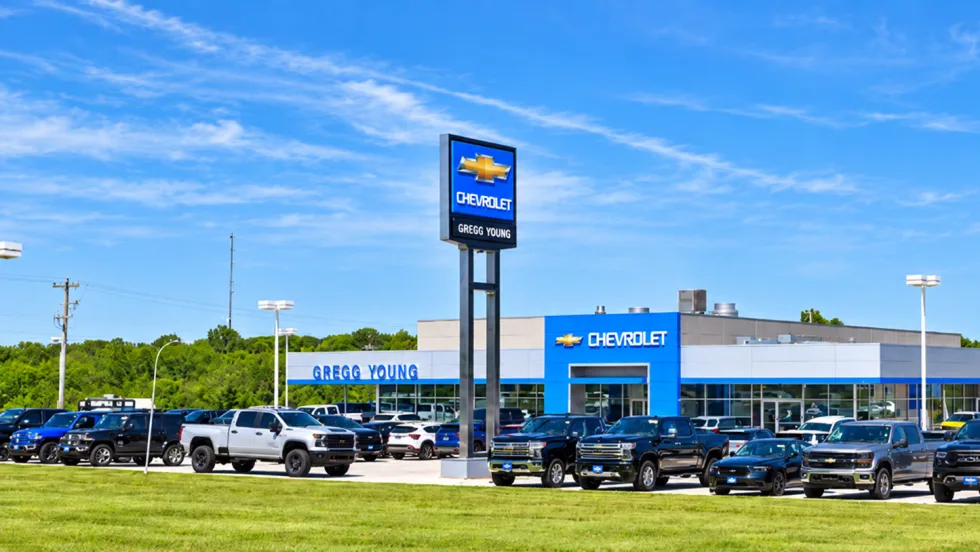
Nebraska Rooftop Changes Hands
The Gregg Young Automotive Group has sold its second dealership to Janssen Auto Group, both in Plattsmouth, Neb.
Read More →
Penske Auto Group Deal a Record
The deal to take the dealership and transportation services company private sets a new pace for industry buy-sell transactions.
Read More →
War Toll a Damper on Used Auto Prices
Cox Automotive found wholesale depreciation to be elevated in September amid high fuel prices and this year's unusual hurricane season.
Read More →
Bridge the Maintenance Gap
With many drivers missing recommended maintenance, service departments offering transparency and efficiency have a better chance of reaching financially strained consumers.
Read More →
California Store Has New Owner
The longtime dealership in the northern part of the state is known for robust fleet sales and has served the state capital for 115 years.
Read More →
BMW Plant Pursues Cleaner Energy
BMW Group Plant Leipzig has utilized hydrogen to help power its production since 2013, but a new pipeline is planned to take it to another level.
Read More →
Auto Affordability Inches Up
The latest Cox Automotive and Moody’s Analytics index shows a slight increase in new-vehicle affordability despite high prices.
Read More →
Ohio Auto Group Under New Ownership
After 79 years with the Schluter family, Mansfield Auto Group has been acquired by Missouri-based Clement Auto Group.
Read More →
RV Group Expands Carolina Footprint
Blue Compass RV Columbia Northeast is the 13th RV dealership owned by Blue Compass in the Carolinas.
Read More →
Agent Acumen
An Agent Summit panel of people who’ve been supporting auto dealers for years gave both timely and timeless advice for those starting out or mulling the prospect.
Read More →