



Detroit Automakers Face Speed Bumps as Sales Growth Slows
Detroit’s automakers, on track for their best sales year since 2006, may want to brace themselves for rockier times ahead, reported Reuters. Auto executives say the industry is as healthy as it’s been since being restructured in 2009. But judging by the recent stock performance of General Motors Co, Ford Motor Co and Fiat Chrysler ... Read More »

Detroit’s automakers, on track for their best sales year since 2006, may want to brace themselves for rockier times ahead, reported Reuters.
Auto executives say the industry is as healthy as it’s been since being restructured in 2009. But judging by the recent stock performance of General Motors Co, Ford Motor Co and Fiat Chrysler Automotive, investors have a less robust view.
Over the past year, GM and Ford share prices have lagged the overall market, in spite of moves by those two companies to give more cash back to shareholders. Fiat Chrysler prices plunged last week as Chief Executive Sergio Marchionne made increasingly overt efforts to drum up interest in a merger with one of his rivals.
“The party may be starting to wind down,” said Charles Chesbrough, senior principal economist for IHS Automotive. “We’re still looking at a good couple years of strong demand, but the days of big sales increases are behind us.”
Optimists include Kurt McNeil, head of GM’s U.S. sales operations, who said Friday that the industry is on track to have its best sales year since 2006. U.S. sales of cars and light trucks are estimated to reach 17 million in 2015, compared with about 10 million in 2009.
U.S. consumer confidence is up, house prices are recovering and gasoline costs less than $4 a gallon in most parts of the country, supporting sales of the big trucks and SUVs that drive profits for the Detroit Three, just as they did before the financial crisis crash in 2008-2009.
But there are warning signals. Sales growth is slowing in the home market, demand for small cars and family sedans is falling, revenues have declined, profits outside North America and China are virtually nonexistent and share prices have flattened.
All three Detroit automakers missed analysts’ expectations for first-quarter earnings. After reporting healthy April U.S. car sales on Friday, stocks fell again at all three.
U.S. sales growth this year has slowed to 6 percent from double digits in 2010-2012. As demand slows, and more companies add production capacity in North America, competition from Asian and European rivals using cheap currencies will intensify. GM’s share of the North American market in the first quarter slipped to 16.4 percent in the first quarter from 16.5 percent a year earlier.
“Over the next couple years, we expect to see the industry cycle down — not next year, but 2017,” said John Hoffecker, managing director and global vice chairman of operations at AlixPartners. Detroit automakers have had “a good strong, long run,” but “there will be a correction from where we are today.”
Before the next downturn, the U.S. carmakers “need to find long-term solutions to sustainable profitability and cost competitiveness,” said Xavier Mosquet, global automotive practice leader for the Boston Consulting Group. “That may be their biggest challenge.”
Part of that solution may be to reduce their dependence on the U.S. market.
The companies need to reduce excess production capacity overseas, especially in Europe and South America, said Matthew Stover, auto analyst with Susquehanna Financial Group. And as U.S. demand slows, they need to generate a higher return on their overseas investments.
Ford and GM are losing money in Europe even after restructuring efforts that included plant shutdowns. GM has said it expects to return to profitability in Europe in 2016. In Latin America, GM and Ford are losing money as the Brazilian economy slows and economic turmoil wracks Venezuela, where Ford earlier this year took an $800 million pre-tax writedown. GM has signaled it could stop Venezuelan production in July. In China, GM’s profit margins fell to 9.9 percent in the first quarter from 11.2 percent a year earlier.
“GM and Ford earn terrific rates of return in North America, but they’re getting killed in Europe and South America,” Stover said.
More Industry
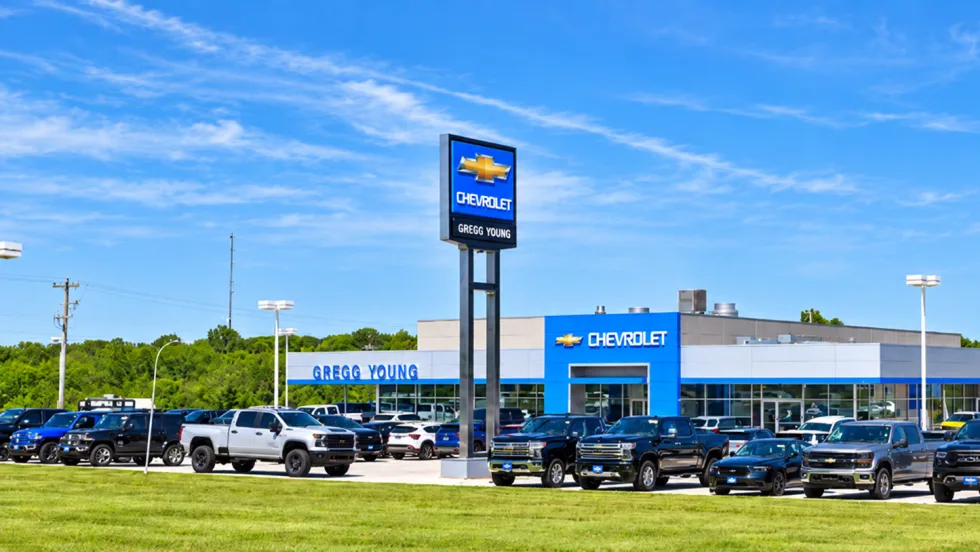
Nebraska Rooftop Changes Hands
The Gregg Young Automotive Group has sold its second dealership to Janssen Auto Group, both in Plattsmouth, Neb.
Read More →
Penske Auto Group Deal a Record
The deal to take the dealership and transportation services company private sets a new pace for industry buy-sell transactions.
Read More →
War Toll a Damper on Used Auto Prices
Cox Automotive found wholesale depreciation to be elevated in September amid high fuel prices and this year's unusual hurricane season.
Read More →
Bridge the Maintenance Gap
With many drivers missing recommended maintenance, service departments offering transparency and efficiency have a better chance of reaching financially strained consumers.
Read More →
California Store Has New Owner
The longtime dealership in the northern part of the state is known for robust fleet sales and has served the state capital for 115 years.
Read More →
BMW Plant Pursues Cleaner Energy
BMW Group Plant Leipzig has utilized hydrogen to help power its production since 2013, but a new pipeline is planned to take it to another level.
Read More →
Auto Affordability Inches Up
The latest Cox Automotive and Moody’s Analytics index shows a slight increase in new-vehicle affordability despite high prices.
Read More →
Ohio Auto Group Under New Ownership
After 79 years with the Schluter family, Mansfield Auto Group has been acquired by Missouri-based Clement Auto Group.
Read More →
RV Group Expands Carolina Footprint
Blue Compass RV Columbia Northeast is the 13th RV dealership owned by Blue Compass in the Carolinas.
Read More →
Agent Acumen
An Agent Summit panel of people who’ve been supporting auto dealers for years gave both timely and timeless advice for those starting out or mulling the prospect.
Read More →