



Black Book: Weekly Market Update
The volume-weighted, overall truck segment decreased 0.50%, smaller than the prior week’s decrease of 0.70%, though all 13 truck segments fell.

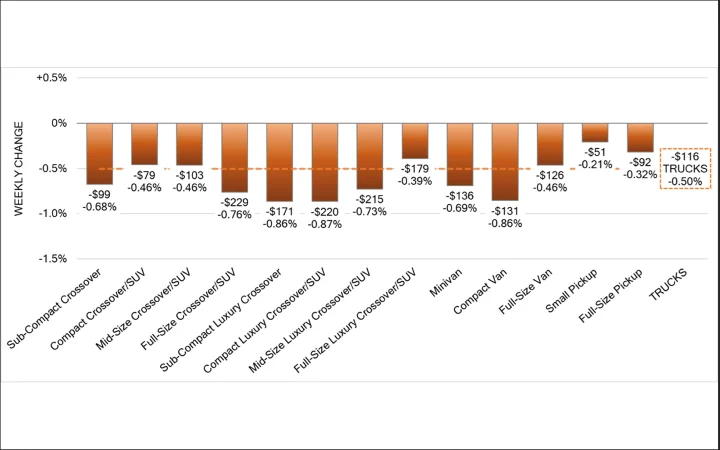
The market continues to decline, and despite the overall drop last week being less than the week prior, the level of weekly declines continues to exceed what's typical for this time of year based on prepandemic trends. Many auctions across the country saw increases in conversion rates and the number of units offered for sale, but the condition of units is a challenge for buyers with low CRs and high mileage.
This Week Last Week 2017-2019 Average (Same Week)
Car segments -0.59% -0.77% -0.29%
Truck & SUV segments -0.50% -0.70% -0.22%
Market -0.53% -0.73% -0.25%
Car Segments
On a volume-weighted basis, the overall car segment decreased 0.59%, following a 0.77% decrease the previous week.
The 0- to 2-year-old segments were also down, but only by 0.46%; 8- to 16-year-old cars declined 0.56%.
All nine car segments decreased.
Compact (-0.94%) and full-size (-0.90%) segments had the largest declines, both with increases in depreciation from the prior week of 0.77% and 0.86%, respectively.
The luxury segments had smaller depreciation; for example, the prestige segment was down 0.40%, compared with the prior week’s depreciation of 0.71%.
Truck / SUV Segments
The volume-weighted, overall truck segment decreased 0.50%, smaller than the prior week’s decrease of 0.70%.
The 0- to 2-year-old segments reported a similar decline last week (-0.50%), but the 8- to 16-year-olds declined less, down 0.44%.
All 13 truck segments reported a decrease.
Compact luxury crossover/SUV (-0.87%), sub-compact luxury crossover/SUV (-0.96%), and compact vn (-0.86%) reported the largest truck segment declines.
The full-size pickup (-0.32%) segment is declining, but the rate of decline continues to be lower than the overall market average. Last week’s decline was the seventh consecutive week, for an average weekly depreciation rate of 0.32%.
Weekly Wholesale Index
The graphic below looks at trends in wholesale prices of 2- to 6-year-old vehicles, indexed to the first week of the year. The index is computed keeping the average age of the mix constant to identify market movements.
Used-Retail Prices
Used-retail prices are more accessible than in past years due to the proliferation of no-haggle pricing. Transparent pricing upfront makes the car-buying process more enjoyable for customers and allows Black Book to accurately measure retail market trends. At the onset of the pandemic, in CY2020, used-retail prices increased slightly, following typical seasonal patterns, then began dropping in April, finally hitting a low point in the late spring months. By late summer of CY2020, they increased as supply of new-vehicle inventory started to become scarce, but retail demand slowed at the end of CY2020, resulting in declining retail asking prices for the last several weeks of the year. When CY2021 kicked off, demand rebounded while retail prices lagged slightly behind wholesale prices; March 2021 started the dramatic increases in used-retail prices, fueled by stimulus payments, tax season and shortages of new inventory. During the third quarter, retail prices continued to rise at a slower rate but soon picked up again to start the fourth quarter, when prices steadily increased. As CY2021 came to an end, the retail listing price index closed 36% above where the year began. The index remained relatively stagnant through most of CY2022. In the fourth quarter of 2022, the Retail Listings Price Index started to decline, but drops weren't as steep as the wholesale price index.
This analysis is based on approximately two million vehicles listed for sale on U.S. dealer lots. The graphic below looks at 2- to 6-year-old vehicles. The index is computed keeping the average age of the mix constant to identify market movements.
Inventory
Used Retail
The Used Retail Active Listing Volume Index reverted back to one at the start of the year. Currently, it sits at 1.01 points.
The used retail days-to-turn estimate is currently around 51.
Wholesale
In the auction lanes, we're still seeing a lot of no-sale and If bids, but surprisingly, conversion rates have moved up slightly over the last few weeks as sellers adjust their floors. As we see new inventory levels improving, the newer used units at auction are seeing some heavier depreciation, particularly with the truck and SUV segments.
The Black Book team of analysts will keep their eyes on the market, watching for developing trends and insights.
The estimated average weekly sales rate continued to improve, increasing to 48% last week.
Originally posted on Auto Dealer Today
More Industry
Nebraska Rooftop Changes Hands
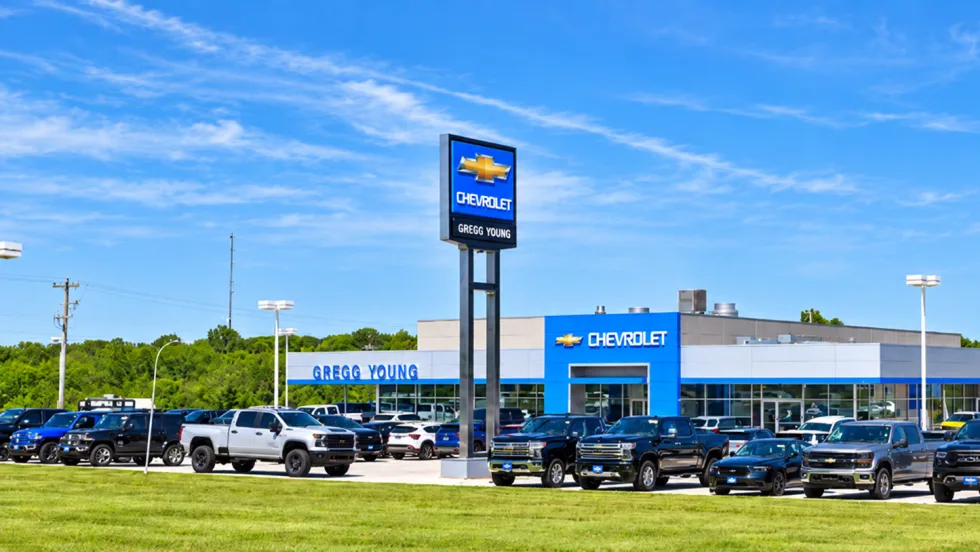
The Gregg Young Automotive Group has sold its second dealership to Janssen Auto Group, both in Plattsmouth, Neb.
Read More →
Penske Auto Group Deal a Record
The deal to take the dealership and transportation services company private sets a new pace for industry buy-sell transactions.
Read More →
War Toll a Damper on Used Auto Prices
Cox Automotive found wholesale depreciation to be elevated in September amid high fuel prices and this year's unusual hurricane season.
Read More →
Bridge the Maintenance Gap
With many drivers missing recommended maintenance, service departments offering transparency and efficiency have a better chance of reaching financially strained consumers.
Read More →
California Store Has New Owner
The longtime dealership in the northern part of the state is known for robust fleet sales and has served the state capital for 115 years.
Read More →
BMW Plant Pursues Cleaner Energy
BMW Group Plant Leipzig has utilized hydrogen to help power its production since 2013, but a new pipeline is planned to take it to another level.
Read More →
Auto Affordability Inches Up
The latest Cox Automotive and Moody’s Analytics index shows a slight increase in new-vehicle affordability despite high prices.
Read More →
Ohio Auto Group Under New Ownership
After 79 years with the Schluter family, Mansfield Auto Group has been acquired by Missouri-based Clement Auto Group.
Read More →
RV Group Expands Carolina Footprint
Blue Compass RV Columbia Northeast is the 13th RV dealership owned by Blue Compass in the Carolinas.
Read More →
Agent Acumen
An Agent Summit panel of people who’ve been supporting auto dealers for years gave both timely and timeless advice for those starting out or mulling the prospect.
Read More →