



Auto Sales Reach an 8-Month High, Helped by Stable Gas Prices

DETROIT — Consumers took advantage of stable gas prices and bought more trucks and sport utility vehicles, which helped push up the sales of new automobiles in the United States to an eight-month high in October.
Automakers said Tuesday that the annual selling rate for the month was slightly above 13.2 million vehicles, the best performance by the industry since February, reported The New York Times.
A big contributing factor was a surge in sales of pickup trucks at General Motors, Ford and Chrysler. The auto companies also reported strong sales of traditional S.U.V.’s and crossover models.
Over all, the industry sold about one million vehicles in the month, a 7.5 percent increase from October 2010.
Besides the relative stability of fuel prices, analysts attributed the strength of the truck and S.U.V. market to a need for consumers and corporate fleets to begin replacing older vehicles.
“There are a growing number of consumers for whom a new vehicle is becoming a necessity,” said Jessica Caldwell, an analyst with Edmunds.com, an auto research Web site.
Sales of pickup trucks rose about 9 percent in October over the same month year ago, and S.U.V. sales climbed about 8 percent, according to the Autodata Corporation, a research firm.
About 53 percent of all vehicles sold during October were trucks and S.U.V.’s. Auto executives said part of the demand was seasonal, as consumers bought more rugged products in anticipation of winter driving conditions.
But the across-the-board rise in sales also showed that consumers were becoming less fearful of spikes in gas prices, and in many cases were choosing the utility of trucks and S.U.V.’s over the higher fuel economy provided by small cars.
“Historically, we have seen that consumers change their buying habits for three to four months when fuel prices are up,” said Rebecca Lindland, an analyst with the research firm IHS Automotive. “There’s still an awareness of gas prices, but at the end of the day consumers are proving that small cars aren’t for everybody.”
Chrysler reported the biggest gains of the Detroit automakers during the month, with a 27 percent increase over the same period a year ago.
The increase was partly a result of new car models like the Chrysler 200 midsize sedan and the tiny Fiat 500 subcompact. But Chrysler also reported a 21 percent increase in sales of Ram pickups, as well as robust sales for S.U.V.’s ranging from the compact Jeep Compass to the seven-passenger Dodge Durango.
By comparison, sales rose about 6 percent at Ford and 2 percent at G.M. Both companies reported increases in full-size pickup sales, which can be interpreted as a positive sign for the overall economy because those models are frequently purchased by contractors and builders.
Ford also said its S.U.V. sales climbed 38 percent during October from a year ago, led by big increases in purchases of the compact Escape model and the midsize Explorer.
Foreign automakers had mixed results during the month. Volkswagen led with a 40 percent increase, followed by Hyundai with a 23 percent gain and Nissan with an 18 percent improvement. Honda sales were flat, and Toyota said its sales declined nearly 8 percent.
Many Japanese models were in short supply during the summer because of production disruptions related to the earthquake and tsunami in March. Inventory levels have recently improved, and some shoppers who put off purchases are now returning to showrooms, analysts said.
The industry’s positive showing could carry over through the end of the year, particularly as consumers continue to replace older-model vehicles.
“The relatively strong selling rate seen in October suggests that the fourth quarter may close stronger than previously expected,” said Jeff Schuster, head of forecasting at J.D. Power & Associates.
Auto sales have been steadily rising since the spring, despite continued high unemployment and low levels of consumer confidence. Many Americans are now replacing their vehicles.
In 2007, the average age of vehicles nationwide was 9.8 years. But that figure has now climbed to 10.7 years, according to Edmunds.com.
“We’re entering a period now where vehicles need to be replaced because they are just getting too old,” Ms. Lindland said. “Replacement demand will be a key to ending the year on a strong note.”
The industry continues to be a bright spot in an otherwise uncertain economic picture nationally, analysts said. October was the eighth consecutive month in which auto sales topped one million.
“That’s pretty resilient when you consider the onslaught of negative news,” said Peter Nesvold, an analyst with Jefferies & Company. “This is not a $500 iPhone. This is a big-ticket, consumer discretionary purchase.”
While G.M.’s overall sales were somewhat below expectations, October turned out to be the best month yet for the Chevrolet Volt, the company’s plug-in hybrid electric car. G.M. said it sold 1,100 Volts during the month, compared with its chief competition, the all-electric Nissan Leaf, which had 849 sales.
More Industry
Nebraska Rooftop Changes Hands
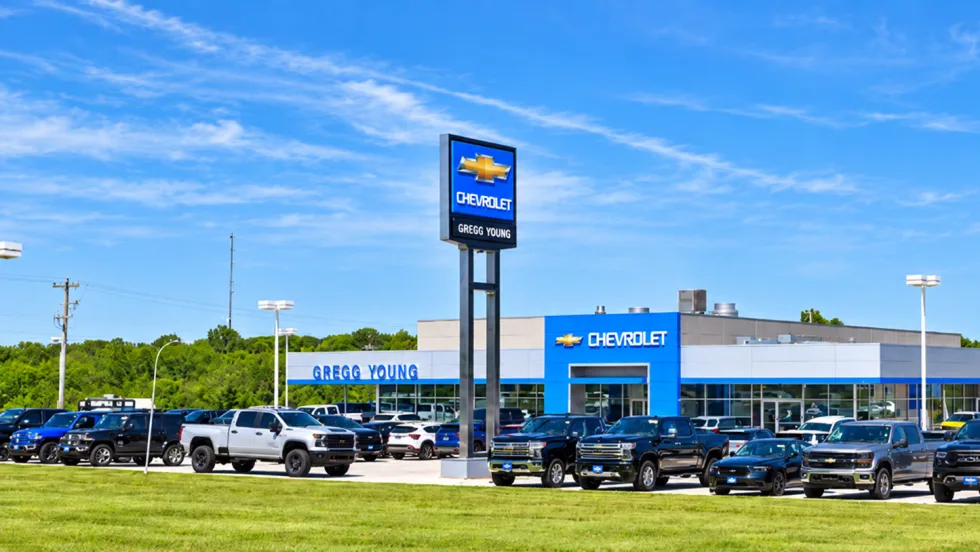
The Gregg Young Automotive Group has sold its second dealership to Janssen Auto Group, both in Plattsmouth, Neb.
Read More →
Penske Auto Group Deal a Record
The deal to take the dealership and transportation services company private sets a new pace for industry buy-sell transactions.
Read More →
War Toll a Damper on Used Auto Prices
Cox Automotive found wholesale depreciation to be elevated in September amid high fuel prices and this year's unusual hurricane season.
Read More →
Bridge the Maintenance Gap
With many drivers missing recommended maintenance, service departments offering transparency and efficiency have a better chance of reaching financially strained consumers.
Read More →
California Store Has New Owner
The longtime dealership in the northern part of the state is known for robust fleet sales and has served the state capital for 115 years.
Read More →
BMW Plant Pursues Cleaner Energy
BMW Group Plant Leipzig has utilized hydrogen to help power its production since 2013, but a new pipeline is planned to take it to another level.
Read More →
Auto Affordability Inches Up
The latest Cox Automotive and Moody’s Analytics index shows a slight increase in new-vehicle affordability despite high prices.
Read More →
Ohio Auto Group Under New Ownership
After 79 years with the Schluter family, Mansfield Auto Group has been acquired by Missouri-based Clement Auto Group.
Read More →
RV Group Expands Carolina Footprint
Blue Compass RV Columbia Northeast is the 13th RV dealership owned by Blue Compass in the Carolinas.
Read More →
Agent Acumen
An Agent Summit panel of people who’ve been supporting auto dealers for years gave both timely and timeless advice for those starting out or mulling the prospect.
Read More →