



Auto Dealer Service Departments Trying to Navigate Parts and Staffing Challenges, J.D. Power Finds
The combination of vehicle owners needing service more often due to accumulating mileage at pre-pandemic levels along with the disruption of the auto parts supply chain and significant staffing shortages is causing auto dealership service departments to navigate unique capacity challenges.

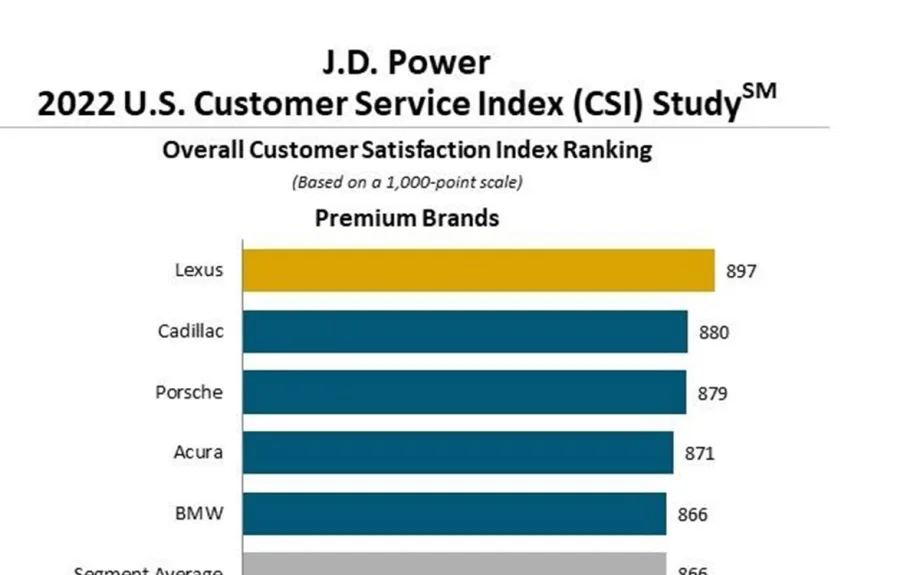
The combination of vehicle owners needing service more often due to accumulating mileage at pre-pandemic levels along with the disruption of the auto parts supply chain and significant staffing shortages is causing auto dealership service departments to navigate unique capacity challenges.
The combination of vehicle owners needing service more often due to accumulating mileage at pre-pandemic levels along with the disruption of the auto parts supply chain and significant staffing shortages is causing auto dealership service departments to navigate unique capacity challenges, according to the J.D. Power 2022 U.S. Customer Service Index (CSI) Study, SM released today.
Wait times to schedule service appointments for one- to three-year-old vehicles have increased by nearly one full day among owners of premium and mass market vehicles (to 4.5 and 4.3 days, respectively). Overall customer service satisfaction is 848 (on a 1,000-point scale).
“Dealer service departments are in a pivotal position to improve customer satisfaction and provide greater customer convenience, even though many challenges—including the parts supply chain disruption and the availability of new-vehicle loaners—are out of their control,” said Chris Sutton, vice president of automotive retail at J.D. Power. “Proactive communication with customers is one solution for dealerships to mitigate a disruptively tough situation. Simply implementing text or email alerts can greatly improve customer satisfaction. Additionally, letting customers know what is happening at each step along the way, including why it is taking longer to book an appointment or providing any updates in parts delays, can help improve satisfaction.”
The study, now in its 42nd year, has been redesigned this year to include emerging features such as valet service, remote vehicle servicing and online/smartphone app payment options to gauge the effect these processes have on the service experience. The study measures satisfaction with service at franchised dealer or aftermarket service facilities for maintenance or repair work among owners and lessees of one- to three-year-old vehicles. It also provides a numerical index ranking of the highest-performing automotive brands sold in the United States, which is based on the combined scores of five measures that comprise the vehicle owner service experience. These measures are (in order of importance): service quality (32%); service advisor (19%); vehicle pick-up (19%); service facility (15%); and service initiation (15%).
Following are key findings of the 2022 study:
Customers trust dealer service departments: The redesigned study also measures factors relating to trust between a customer and the dealership. On a rating scale of 1 to 7 points, the most important trust attribute is, “I trust the dealership to perform complex repairs on my vehicle,” with an average rating of 6.16. However, the second-most important attribute, “Takes responsibility when a mistake is made and resolves it effectively,” has the lowest average rating (5.91).
Your vehicle is ready: The service department sending simple text messages to remind of upcoming appointment dates or to provide a status for in-process work are preferred by 42% of customers. Additionally, owners today gravitate toward other technology channels to communicate with the service department, including making appointments online (27%) and via mobile app (7%), and paying online (17%). “Dealers who meet customers on their preferred communication channels are gaining an advantage,” Sutton said. “Service departments need to jump on the technology train now or risk being left behind.”
Seeing is believing: New to the redesigned study is a metric that measures satisfaction when the service department provides a recommended photo or video of repair work with the customer after a multi-point inspection and before needed work is approved. This additional communication feature is having a positive effect on business and trust, as well as on customer satisfaction. When customers receive a photo or video communication regarding their needed maintenance work, they are three times more likely to have advisor-recommended work done. Additionally, on a 7-point rating scale, dealerships are building a higher level of trust with customers (.39 point higher) than are their counterparts who do not provide a photo or video.
If you go to them, satisfaction will improve: New to the study in 2022 is a measurement of satisfaction among customers who select to have their vehicle serviced either by valet (when a dealership picks up the vehicle) or mobile (when the dealership sends a technician to the customer’s location). Overall customer satisfaction among owners using valet or mobile service is 866 compared to 847 among those who had an in-person dealership visit.
Next frontier is battery electric vehicle (BEV) service experience: With BEV sales expected to increase in the coming years, dealers have a significant service quality satisfaction gap to close. Overall service satisfaction among BEV owners (784) is 68 points lower than among owners of gas- or diesel-powered vehicles (852). Additionally, the average number of service visits a BEV owner makes in a year is 1.9 compared with 2.4 among owners of gas- and diesel-powered vehicles. “BEV service is the next frontier for dealerships,” Sutton said. “The automotive industry has to get ready now and get the service experience right with BEV owners or they risk losing them to aftermarket service providers. This includes fully understanding BEV customer pain points like range anxiety, unique maintenance requirements and support for related services such as availability of charging stations.”
More Industry
California Store Has New Owner
The longtime dealership in the northern part of the state is known for robust fleet sales and has served the state capital for 115 years.
Read More →
BMW Plant Pursues Cleaner Energy
BMW Group Plant Leipzig has utilized hydrogen to help power its production since 2013, but a new pipeline is planned to take it to another level.
Read More →
Auto Affordability Inches Up
The latest Cox Automotive and Moody’s Analytics index shows a slight increase in new-vehicle affordability despite high prices.
Read More →
Ohio Auto Group Under New Ownership
After 79 years with the Schluter family, Mansfield Auto Group has been acquired by Missouri-based Clement Auto Group.
Read More →
RV Group Expands Carolina Footprint
Blue Compass RV Columbia Northeast is the 13th RV dealership owned by Blue Compass in the Carolinas.
Read More →
Agent Acumen
An Agent Summit panel of people who’ve been supporting auto dealers for years gave both timely and timeless advice for those starting out or mulling the prospect.
Read More →
Missed Maintenance Creates Opportunity
As families get back on the road and into daily school routines, service drives have an opportunity to capture customers who are behind on recommended vehicle maintenance.
Read More →
Mitsubishi Unveils U.S. Plan
The automaker announced a strategy that includes an expanded lineup and dealership presence, along with more ‘rugged’ and electric models.
Read More →
Selling to Grow
The question of whether you should sell your agency and if so, when, is up to you. But it’s a question worth asking to ensure you keep the business on the right path for yourself, employees and clients.
Read More →
Recalled Vehicles Hit 5-Year High
Though the number of events has fallen so far this year, impacted units are up significantly. Meanwhile, regulators consider consumer notification changes.
Read More →