



Dealers Will Feel the Impact of Tax Reform
Learn how new rules introduced by the Trump administration’s Tax Cuts and Jobs Act will affect interest expenses and depreciation deductions for U.S. auto dealers.
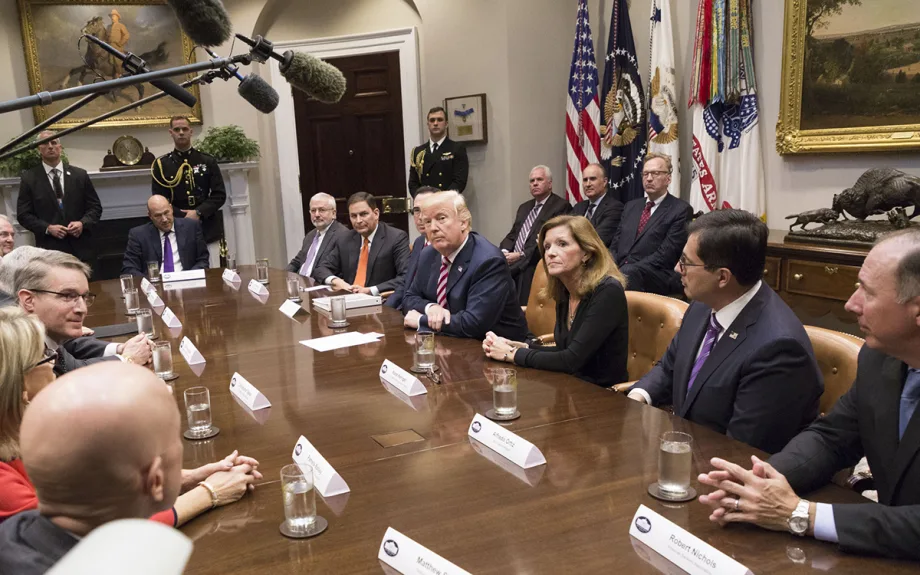
President Donald Trump met with business leaders and experts on Oct. 31, 2017, shortly before the passage of his administration’s sweeping tax reform package.
Photo courtesy The White House
The Tax Cuts and Jobs Act has brought with it many changes that impact business owners. Auto dealers in particular need to be aware of the impact of these changes and plan accordingly.
The act has made two notable changes as it relates to bonus depreciation: First, prior to its passage, bonus depreciation was only applicable to items purchased as new; now it applies to new and used tangible property. Second, before the change in the law, bonus deprecation deduction was only 50% of the purchase price of tangible property; with the passage of the act, that amount is raised to 100%. Unfortunately, auto dealers will not be able to benefit from the additional bonus depreciation.
Prior to the passage of the act, interest paid or accrued by business entities was generally fully deductible. Now, the interest deduction for most businesses with over $25 million in gross receipts is limited to 30% of the adjusted taxable income for the tax year. The good news is that auto dealers are exempt from this rule, but at a cost — they are not eligible to utilize the 100% bonus depreciation benefits.
There Is Some Good News
Auto dealers secure their lending by using their inventory as collateral. The act exempts the interest paid on such floorplanning from the interest deduction limitation. This is a great benefit to those dealerships that are not performing very well since they are the ones who have the most exposure to the interest deduction limitation.
However, there is a cost to this benefit. Those that use floorplan financing are not allowed to use bonus depreciation effective for tangible property acquisitions after Jan. 1, 2018. On the brighter side, the Section 179 deduction increased from $500,000 in 2017 to $1,000,000 in 2018, with a phaseout for acquisitions in excess of $2.5 million.
For profitable dealerships, the increase in Section 179 expensing can offset some of the benefits lost due to the disallowance of bonus depreciation.
In addition, the first-year deprecation for “luxury vehicles” is $10,000; with bonus depreciation, it would be $18,000 in the first year. This is an increase over the prior-year amounts. This is most helpful for those dealers who take depreciation on their loaner fleets.
What to Do Now
The passage of the Tax Cuts and Jobs Act has created or enhanced some tax breaks for auto dealers. It has also reduced or eliminated others. Specific to the changes discussed regarding interest expenses and bonus deprecation, it is important that all auto dealers consider tax planning strategies which make the most sense for your particular operation.
For example, as opposed to floorplanning your inventory, you may opt to finance your inventory with a traditional line of credit based on its net worth. As long as the inventory is not used as collateral, which would make it a floorplan loan, you would be subject to the 30% interest expense limitation. But you could still be allowed to use the 100% bonus depreciation. The key is to determine what would work best for you.
This is just one example of how your automotive dealership can plan to maximize the potential benefits found in this tax legislation.
Ed Blum and Rosamaria D. Bravo are certified public accountants and principals in the Tax and Accounting department at MBAF. No part of this article is intended as legal or financial advice.
Originally posted on Auto Dealer Today
More Industry

War Toll a Damper on Used Auto Prices
Cox Automotive found wholesale depreciation to be elevated in September amid high fuel prices and this year's unusual hurricane season.
Read More →
Bridge the Maintenance Gap
With many drivers missing recommended maintenance, service departments offering transparency and efficiency have a better chance of reaching financially strained consumers.
Read More →
California Store Has New Owner
The longtime dealership in the northern part of the state is known for robust fleet sales and has served the state capital for 115 years.
Read More →
BMW Plant Pursues Cleaner Energy
BMW Group Plant Leipzig has utilized hydrogen to help power its production since 2013, but a new pipeline is planned to take it to another level.
Read More →
Auto Affordability Inches Up
The latest Cox Automotive and Moody’s Analytics index shows a slight increase in new-vehicle affordability despite high prices.
Read More →
Ohio Auto Group Under New Ownership
After 79 years with the Schluter family, Mansfield Auto Group has been acquired by Missouri-based Clement Auto Group.
Read More →
RV Group Expands Carolina Footprint
Blue Compass RV Columbia Northeast is the 13th RV dealership owned by Blue Compass in the Carolinas.
Read More →
Agent Acumen
An Agent Summit panel of people who’ve been supporting auto dealers for years gave both timely and timeless advice for those starting out or mulling the prospect.
Read More →
Missed Maintenance Creates Opportunity
As families get back on the road and into daily school routines, service drives have an opportunity to capture customers who are behind on recommended vehicle maintenance.
Read More →
Mitsubishi Unveils U.S. Plan
The automaker announced a strategy that includes an expanded lineup and dealership presence, along with more ‘rugged’ and electric models.
Read More →