



F&I Still Revved Up in Q2
StoneEagle data show growth and products’ outsize role in profit protection.

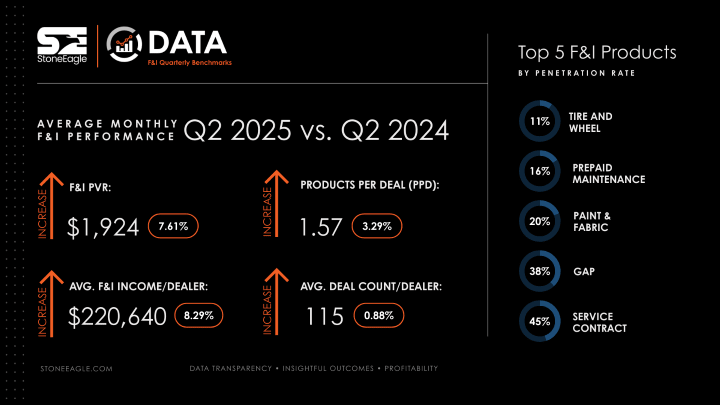
Most auto dealer F&I metrics rose in the second quarter, according to StoneEagle data.
StoneEagle
Finance-and-insurance product sales are helping shore up auto dealership revenues as consumer affordability and trade tariff challenges threaten front-end profits.
Though average front-end dealer gross profit in June totaled $695 per vehicle, down 26% since January and 40% from the 2024 peak, F&I results headed in the opposite direction, industry provider StoneEagle reported.
The front-end picture, though faded, was still up sharply from prepandemic levels, the company pointed out – by 72%.
Meanwhile, dealers’ average F&I profit per vehicle rose by about 5% quarter-over-quarter and 8% year-over-year to $1,924. Products per deal inched up from 1.54 in the first quarter to 1.57 – the average a year earlier was 1.52.
Average monthly F&I revenue also increased, up 8% both quarter-over-quarter and year-over-year to $220,640, StoneEagle calculated.
Consequently, gross profit per vehicle in June averaged $2,625, up 10% year-to-date and eclipsing prepandemic levels by 59%.
Though F&I revenue has receded somewhat from a robust March, when many consumers descended on dealers to beat anticipated vehicle price inflation resulting from U.S. trade tariffs, F&I remains a humming profit engine for dealers, StoneEagle said.
“It’s a testament to the resilience of F&I and its ability to steady the business when other parts of the dealership come under pressure,” said company CEO Cindy Allen.
Service contracts increased their share of F&I sales by a percentage point year-over-year to 45% penetration, according to the report, followed by the same jump for gap coverage to 38% and paint-and-fabric protection to 20%. Prepaid maintenance was flat at 16%, and tire-and-wheel plans rose a point to 11%.
LEARN MORE: In F&I, Innovation Is Overrated
Originally posted on F&I and Showroom
More Product & Technology

Computer Headaches on the Road
Consumers keep complaining about new cars’ infotainment tech, but are automakers listening? A recent survey shows regression except for mapping and speakers.
Read More →
Another Death Tied to Imported Air Bags
The Texas traffic fatality is the 11th federal regulators have connected to defective inflators imported from China. They urge that a certain population of used vehicles be inspected.
Read More →
Roadside Warnings Debut
Mazda works with AAA and a technology company to alert passersby to stranded vehicles from its lineup, for both parties’ safety.
Read More →
AI As Trainer?
This month, Agent Entrepreneur Editor Hannah Mitchell shares an artificial-intelligence development that could upend traditional dealership training.
Read More →
A Lingering Auto Tech Divide
Automakers still struggle to hit consumers’ sweet spot, hanging onto the despised touchscreen and adding other complex systems while simple, effective details hit the mark.
Read More →
AI, China and the Next Wave of Auto Retail Innovation
F&I sits at the center of the changes expected to sweep the industry in just the new few years as new players change the game.
Read More →
That Bot Can Do a Lot
Artificial intelligence was all the buzz at the 2026 Agent Summit. A panel of tech specialists broke through the noise to give agents guidance on steering dealer clients.
Read More →
Cyber F&I
Your dealer clients could only benefit from showcasing products on their websites along with vehicle inventory. Modern consumers expect to be informed and are more likely to buy products when they are.
Read More →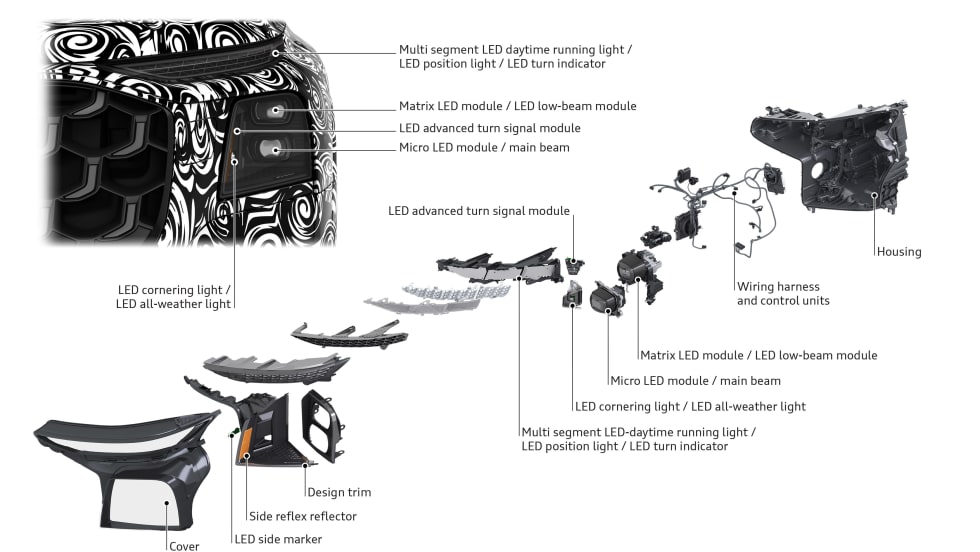
Road Glare to Drop a Notch?
Audi is preparing two SUV models for the American market with the automaker’s adaptive LED headlights. Its technology is designed to reduce brightness for other drivers, a growing complaint among U.S. motorists.
Read More →
AppOne Partners With RouteOne for E-Contracting Solution
By digitizing the entire contracting and funding process, the company says auto dealers can eliminate frustrating and disorganized manual processes.
Read More →