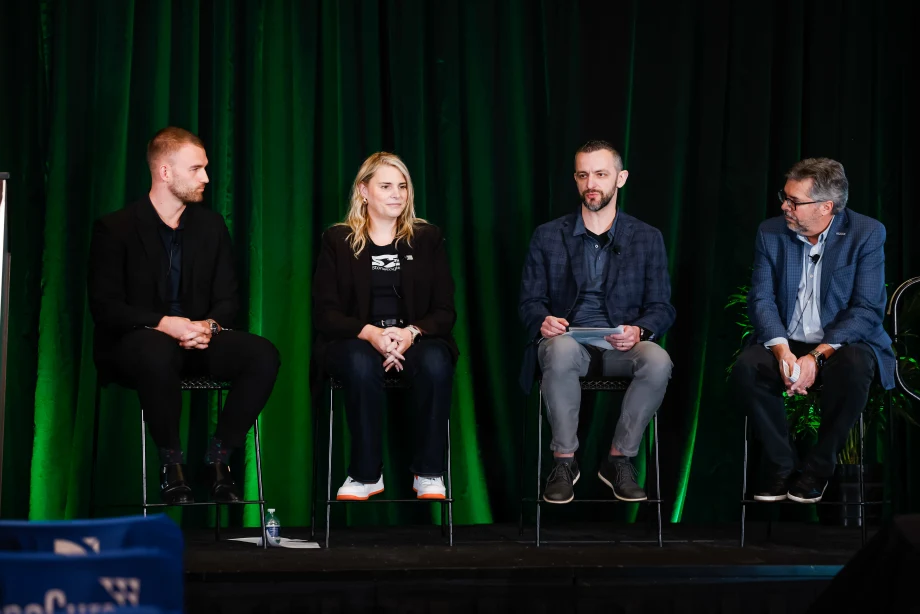
Artificial intelligence was all the buzz at the 2026 Agent Summit. A panel of tech specialists broke through the noise to give agents guidance on steering dealer clients.
Artificial intelligence hovered over this year’s Agent Summit like a bot prompt at the bottom of a retailer’s homepage. It wasn’t going away, and at least most event speakers declared that it’s here to stay.
Finance-and-insurance veteran Justin Gasman, now an F&I trainer for Reahard & Associates, heard both AI haters and latecomers talk about it at the annual event. Moderating a panel of technology experts who discussed large-language models’ role in the car dealership, he gently encouraged agents to embrace the disruptive technology and help dealers do so.
“Whether you believe it or not, whether you like it or not, it’s here,” he said, adding that if agents and dealers don’t embrace that reality, “you will be left behind.”
Trusting the Machine
Gasman’s questions to the panelists therefore focused on how to make AI work in auto retail. He started the discussion with the obvious challenge: how to trust machines to do things only people have heretofore.
Panelist BreAnna McCready said dealers must start with knowing where the data they’re feeding to their AI platforms originates and assessing the AI platforms they’ll use. Agents should start by asking their dealer clients whether they’ve signed data processing agreements with their AI providers.
“If you’re using the free version and you don’t have an enterprise account, you’ve got a lot risk on your hands,” said McCready, who leads growth strategy and innovation for StoneEagle. “But if you have a DPA that you’ve spent time with, that your [general counsel] has spent time with, now we’re in a different position.”
Do They Comply?
Once trust has been established, the tool of choice must help dealers’ bottom lines and do so in accordance with regulations.
Panelist Gavin Janis, director of automotive for Siro, whose AI tech records and analyses sales interactions for coaching, said such tools help dealers assess finance managers’ practices to ensure they’re effective and compliant.
Janis described a case when Siro’s tool reviewed an F&I manager’s meetings with customers and discovered the manager told customers a bank required a particular F&I product to grant them a certain loan rate, a regulatory no-no. The dealer’s agent provided the feedback to help it steer itself inside legal bounds.
“… that’s going to be a client of theirs for a long time,” Janis surmised.
The People Factor
Despite AI tools’ capabilities, there’s still plenty of room for human error, Gasman acknowledged. He asked the panelists how agents and their dealer clients can head such mistakes off at the pass.
“What happens when a dealer has an employee that takes data like a CSV file,” Gasman said, “and they dump that into their Open AI, free version of [Chat]GPT or whatever their flavor of the week is, and now all that customer data is in some sort of open AI?”
Downshifting human actions is a must, despite the “exponential” swiftness of AI and its ever-morphing capabilities, as Gasman pointed out, said panelist Greg Kasprzycki, vice president of solutions at PCMI, which provides F&I administration software.
“Obviously, we’re used to the fact that we’re getting the information back very quickly, but we … do have to slow down just a little bit just to make sure we don’t create a monster we’ll have to be dealing with later on.
“You don’t have to go from zero to 60 in two seconds. Maybe you can go in seven seconds. It’s just slowing, taking a break. The important thing is not removing the human from the equation.”
In fact, Kasprzycki said he expects AI will strengthen agents’ relationships with dealers.
Technological Muscle
Once baseline guardrails are in place, dealers can leverage AI to boost profits, panelists said. Gasman asked them about pumping up F&I sales in particular.
Doug Betts, president of JD Power’s dealer solutions division, said AI has crunched auto warranty claims data to the point that it can predict shortly after a model launch how that model’s repair needs will manifest over their lifetimes, including which parts will require replacement and how often. He said that currently F&I actuaries typically look at performance from three years earlier.
“There’s a real opportunity to have a more clear understanding of what’s going to happen to the car that I’m now offering a policy for,” he said, adding that dealers can stock parts likely to break.
“There’s also a lot that can be done on the selling side when you know that this car is on this path, which may be different than historically what that particular model had been before.”
Since dealers are facing fraud from many angles today, panelists discussed how AI might help them fight it and ideally prevent it.
Kasprzycki pointed out one of AI’s strengths: detecting patterns in data, “instead of just rule engines, which could be easily changed, or people will find a way to break those rules.”
Where to Start?
Given AI’s scope and complexity, it can be overwhelming for agents and dealers, especially those just dipping their first toe into the AI ocean. Gasman asked the panelists for ideas on where agents can land that toe.
“Get logged into Claude Cowork (by Anthropic) and figure out how it works,” Janis said, meaning describing to the platform what you’re seeking to accomplish.
Kasprzycki chimed in with, “Don’t overthink it. Just ask a very specific question, and it’s going to give you a prototype, a report. Just go with it.”
For McCready, it makes sense for agents to educate themselves on the platforms. “They’re not one-size-fits-all,” she said. “They have different intents.”
She illustrated this fact by describing a meme her 17-year-old daughter developed to characterize the various AI platforms on today’s market based on high school stereotypes:
OpenAI’s ChapGPT is an excitable, “kind of dumb” cheerleader. Google’s Gemini is a “nepo baby,” after the offspring who feeds off his or her parent’s wealth, fame or social advantages. Anthropic’s Claude is the class valedictorian, and Perplexity is the research nerd.
“Does that apply for the use case that you’re trying to use?” she said. “There’s just different applications for different platforms.”
McCready said she prefers Claude but advised agents to familiarize themselves with any AI platforms their dealer clients use.
Betts emphasized that, regardless of the chosen platform, it’s only as reliable as the data the dealer feeds it, so agents should counsel their clients to get data from reliable sources and clean up internal data before they take that step.
If they don’t, they’re “going to get wrong answers, he said, and, “It’s not Claude’s fault. Claude is using the data to answer the questions.”
Back to the Human
Claude or no Claude or other AI tech, the panelists agreed that the one thing it should never replace is human intelligence.
“We’re in a people business,” McCready said, “and although there’s a lot we can automate, and we can make our customers’ lives better in a thousand different ways, there’s still a human interaction that’s absolutely important.”
She said she requires her own account-management teams to meet with their clients in person at least once a year.
Betts pointed out that after car factory automations in the 1970s led to robots replacing people for welding, painting and more, automakers found that the machines couldn’t reliably assess paint defects or color nuances, for instance, a job still done by people.
Similarly, AI can’t make fine-tuned judgements about people in particular, he said.
“When that body language, that twitch, that shock that comes over [a person’s] face, it’s not going to know that it’s in the process of destroying a deal or turning an advocate into somebody who’s against the company. It’s the human touch.”
Gasman agreed as he closed out the discussion. “As much as people think they don’t want a salesperson or an F&I manager, they do. They just don’t want the bad one they had last time.”
LEARN MORE: BMW Group Invests in AI